


MDF, Particle Board or Plywood: Specify Cabinets by Component
Specify cabinet boxes, backs, shelves and door fronts separately: compare substrates, finishes, thickness, edge treatment and project documentation.
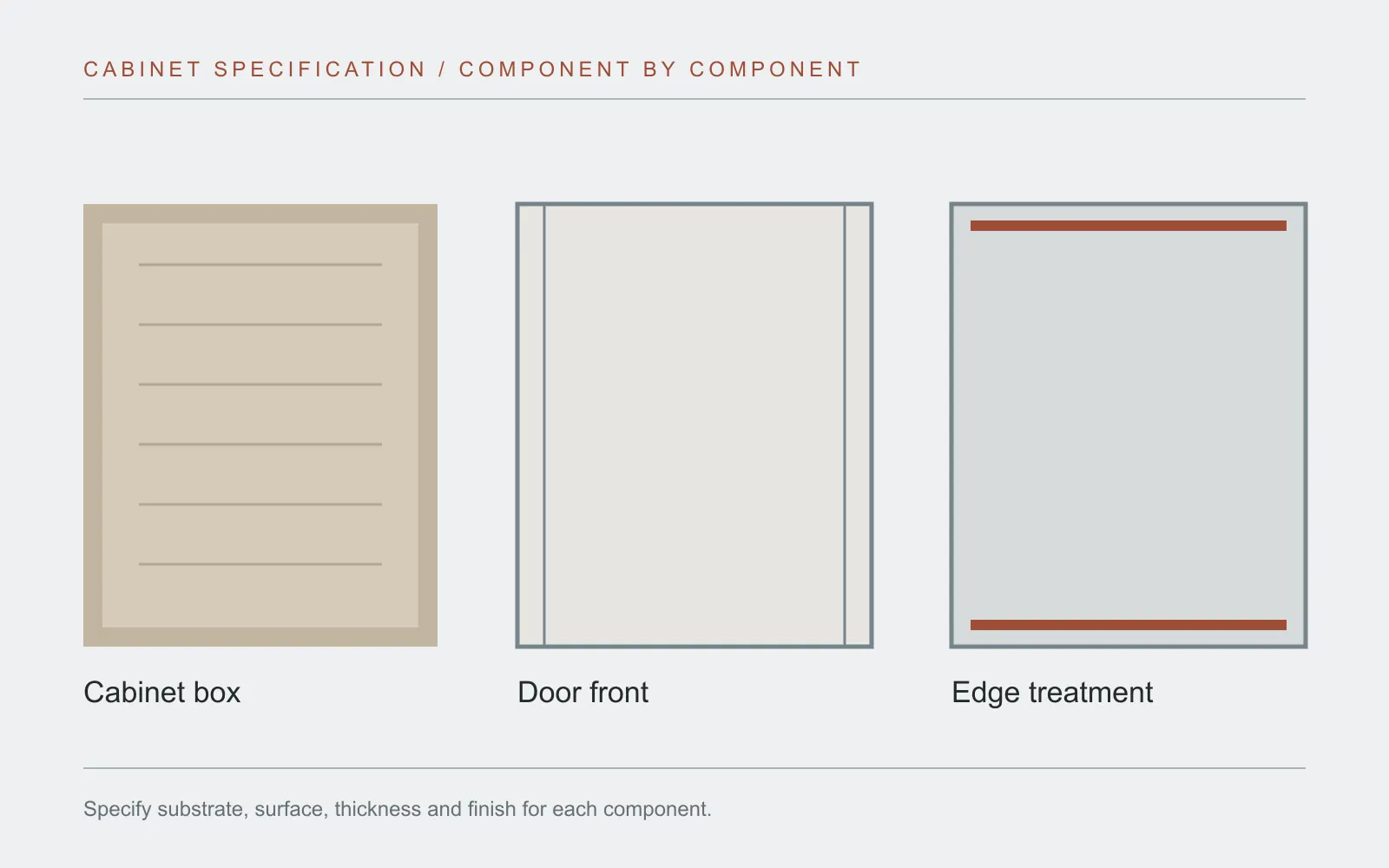
Choose cabinet boards by component and intended use, rather than asking for one material to cover the entire kitchen. A door face, a shelf and a cabinet box have different requirements. MDF, particle board and plywood describe material families; the exact grade, thickness, finish and construction still need to be specified.
Where each material enters the discussion
MDF is made from wood fibres and resin. Its uniform surface makes it a candidate for painted fronts and routed door designs. Confirm the specified grade and the finishing system for the intended room.
Particle board uses wood particles and adhesive. It is commonly considered for cabinet interiors and shelving, including melamine-faced components. Compare the complete specification, including the face finish and edge treatment, rather than the board name alone.
Plywood is built from bonded veneer layers. It can be considered for cabinet boxes and shelves where the design calls for it. The panel grade, thickness, joints and support arrangement remain part of the decision.
None of these names alone establishes a finished cabinet’s moisture resistance, emissions compliance or load capacity. Request documentation for the actual panel and intended application when those requirements are part of your project.
Specify the component, not just the board family
| Component | Record before approving the quotation |
|---|---|
| Cabinet sides, top and bottom | Substrate, nominal thickness, face finish, exposed-edge treatment and jointing method |
| Back panel | Material, thickness, how it is fitted and whether its finish remains visible |
| Shelf | Material, thickness, span, support and intended contents |
| Door or drawer front | Profile, substrate, surface on both faces, edge treatment and hardware preparation |
SNEJ training material illustrates one whole-house cabinet configuration with an 18 mm cabinet board, 9 mm back panel and PUR edge-banding process. These numbers describe that configuration; they are not a blanket specification for every cabinet or wardrobe. Ask for the actual construction schedule for the range quoted to your project.
Why exposed edges need a specification
Cut cabinet panels leave edges that require a suitable finish where they remain exposed. Edge banding affects appearance and helps protect the panel edge during normal use, but the result depends on the panel, band material, adhesive, application and installation details together. For kitchens, ask which exposed edges receive banding, how corners and sink-adjacent panels are treated, and what happens at joints or cut-outs. PUR describes one adhesive process; it does not guarantee a particular moisture rating or service life for every cabinet. Request the proposed edge detail and any test evidence needed for the project’s conditions.
The training material also discusses rubberwood-core board and MDI adhesive. A board’s composition and its adhesive system are separate facts. A claim about no added formaldehyde in an adhesive must not be read as a claim that a finished panel releases none. If an emissions class or destination-country test matters, identify the particular panel, standard and report to be reviewed.
What to record before comparing quotations
Ask each supplier to identify:
- The material and thickness for the doors, cabinet sides, backs and shelves.
- The surface finish and edge treatment for each component.
- The hardware and fixing arrangement included in the design.
- Any project-specific documentation required for the destination market.
For a coordinated kitchen and wardrobe package, use the same schedule format for both product groups. The visible front may use a different construction from the cabinet box even if their colour references look alike.
First align what is included, then compare the prices.
Keep the finish decision connected to the board
A colour reference does not identify the material beneath it. Review the board and the visible surface together, and approve a physical sample for the selected finish.
See the cabinet finish selection guide and include the agreed material schedule in your kitchen quotation brief. SNEJ can discuss free samples, with shipping paid by the buyer, before you send the project enquiry.